

Where Leaders Stand and What They Must Show by Year-End
AI transformation has moved rapidly from experimental initiatives and basic task automations to a strategic business imperative that drives competitive differentiation.
But the speed of this transition is outpacing many organizations’ ability to account for it: according to IBM research, 70% of the IT leaders say their companies are deploying tech systems faster than their IT teams can track.1
Despite this disparity, 2026 has become the year of accountability. By December 31st, leaders will be expected to show measurable progress on both productivity and profitability. This brief highlights where leaders stand with AI right now, and what they’re being asked to specifically deliver by year-end.
Where Leaders Stand with AI
According to Deloitte’s 2026 State of AI in the Enterprise Report, 34% of companies are starting to use AI to deeply transform their businesses. Yet, 37% of leaders are still “only using AI at a surface level with little or no change to underlying business processes.”2 This gap makes sense when you consider that strategic intent and operational readiness rarely move at the same pace. Case in point: 42% of leaders feel strategically ready for AI, whereas only 20% feel operationally ready.2
This research tracks with the reality of our own clients and industry peers. During our recent AI webinar, we asked leaders in attendance about the progress and challenges of their AI journey. 50% are already actively executing multi-year transformations, yet 33% cite unrealistic expectations about readiness as their single biggest challenge by a wide margin.
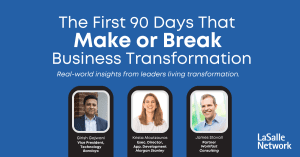
Responses from our March 2026 “The First 90 Days That Make or Break Transformation” webinar for leaders and senior managers.
Where does your organization currently stand in its transformation journey?
- We are planning a transformation initiative (17%)
- We are in the first year of transformation (25%)
- We are actively executing a multi-year transformation (50%)
- We have recently completed a transformation initiative (8%)
What is your biggest challenge when launching transformation initiatives?
- Lack of clearly defined business outcomes (17%)
- Misalignment across leadership teams (17%)
- Workforce resistance or change fatigue (17%)
- Difficulty measuring progress early (17%)
- Unrealistic expectations about readiness (33%)
The gap between AI ambition and operational readiness will only widen as pressure to show results intensifies.
“In conversations with our customers, many are either operationally structured for AI success but lack a formalized strategy to move forward. Or, they have an impressive on-paper roadmap that struggles to gain traction in practice. It’s very much this or that at a time when a competitive market demands it be this AND that. The good news is, we’re able to advise on closing that gap from either end, and it’s easier than you think with the right approach.”
–Jeff Panning, Vice President, LaSalle Network
5 AI Results Leaders Must Show by Year-End
Despite AI budgets doubling in 2026 to nearly 1.7% of total corporate revenues, operational execution remains a bottleneck leaders can no longer afford to ignore.3 By the end of this year, bottom-line proof must be shown, with these five results being most vital.
Result #1: Concrete ROI
THE DRIVER
Pressure to move from abstract vanity metrics to hard proof of P&L impact.
WHAT THE DATA SHOWS
Moving the EBIT needle. Only 39% of organizations report an AI impact on EBIT (Earnings Before Interest and Taxes)4, which is typically less than 5%.5 And only 5% of companies are achieving AI value at scale.6
Sales Seeing Value. 31% of CSOs (Chief Sales Officers) cite difficulty proving ROI of AI-driven tools as their top challenge.7
THE TAKEAWAY
The days of measuring AI activity rather than AI results are over. Today’s companies are pressed to deliver strategy and execution that achieves or exceeds company goals, with a direct line connecting efforts to profits. This goes beyond basic productivity improvements, requiring strategic, outcomes-based metrics for transformational organizational initiatives.
Result #2: Production at Scale
THE DRIVER
Demand to pivot from experimental concepts to a major portion of AI roadmaps being live and workflow-integrated.
WHAT THE DATA SHOWS
Rampant acceleration. The number of companies with greater than 40% of AI projects in full production is set to double in 6 months.2
C-Suite Pressure. Operationalizing AI is the #1 functional priority for CIOs.8 Yet, only 34% of enterprise leaders are truly reimagining their businesses through deep transformation.2
THE TAKEAWAY
One-off proof-of-concepts and experimental micro initiatives are no longer the priority. Leaders must move to production 2.0, exponentially advancing mission-critical AI roadmaps across the enterprise and every operational workflow.
Result #3: Agentic-First Delivery
THE DRIVER
An accelerating operational shift from human-in-the-loop dependencies to fully autonomous workflows.
WHAT THE DATA SHOWS
Lack of Readiness. CIOs expect a 38% increase in the number of AI agents deployed by next year, yet just one in 10 IT leaders are prepared for that scale of deployment.9
CEOs Taking Lead. 80% of CIOs and CTOs report transformation mandates coming directly from the CEO.1 72% of CEOs say they are the main AI decision makers, with 90% expecting AI agents to drive measurable ROI this year.10
Oversight Limitations. Two-thirds of CIOs and CTOs say they’re accountable for AI systems they don’t fully control.1
THE TAKEAWAY
The C-Suite must satisfy stakeholders by demonstrating deployment and integration of autonomous workflows across the business, with CEOs feeling the lion’s share of pressure. In turn, CIOs, CTOs, and line of business leaders are being pressed to prove agentic AI progress.
Result #4: Workforce Literacy
THE DRIVER
Requirement to move beyond demonstrated internal adoption to proven AI mastery across users and use cases.
WHAT THE DATA SHOWS
Tech Outpacing Skills. The AI skills gap remains the #1 barrier to enterprise integration2 as leading companies allocate as much as 60% of their total AI corporate budgets toward retraining current talent.10
THE TAKEAWAY
Having AI tools in place is not the same as having a workforce that can meaningfully apply them. This gap between adoption and mastery is where most organizations are stalling. All the AI licenses in the world are meaningless without embedded organizational AI literacy to drive transformation and measurable ROI. Leaders must prove their teams are as nimble as their tech stack, starting with the right workforce model and AI expertise.
RESULT #5: Robust Governance
THE DRIVER
Pressure to prevent autonomous AI from causing devastating financial, regulatory, and reputational harm.
WHAT THE DATA SHOWS
Risk Prevention Immaturity: Security and risk concerns are the #1 barrier to scaling agentic AI;11 not surprising given only 1 in 5 companies have a mature governance model.2
Incident Response Inadequacy: AI incident volume has remained steady at 8% YoY, but dissatisfaction with incident response has increased: 21% of organizations say it needs improvement (vs. 13% last year); 5% say it’s insufficient (vs. 2% last year).11
Manual Reliance: Those that engineer control into their AI systems deploy 16x more agents than those relying on manual governance, while spending 4x less of their AI budget and delivering 18% higher operating margins.1
THE TAKEAWAY
Stakeholders demand reassurance from CIOs, CISOs, and CROs that agentic agents won’t negatively impact company processes or profits. Leaders must make AI governance a priority vs. an afterthought, establishing audit-ready guardrails, explicit accountability roles, and clear, actionable incident response protocols.
“AI integration is not simply a line item or a technology play. It’s a core foundational element that serves as the blueprint for business transformation at every level. Organizations must recognize this and act on it to have any hope of competitive differentiation and operational success. There can no longer be any illusions when it comes to AI progress.”
— Zach Vogel, CEO, LaSalle Network
High-performing organizations recognize this risk. They approach AI deployment not as an experiment, but as a core strategy.
Closing the AI Investment-Results Gap
According to Boston Consulting Group (BCG) research, 90% of CEOs believe by 2028 AI will redefine what success looks like within their industry.3 Today, 50% of organizations using gen AI are expected to deploy autonomous AI agents across company workflows by 2027.12
But for AI transformation itself to be successful, organizations must have mechanisms in place to seamlessly implement and clearly measure the impact of autonomous integrations. This takes:
- An outcomes-first strategy: Define your #1 goal of AI transformation and architect your roadmap back to that. This helps ensure stakeholder alignment, proactively uncover silos or roadblocks, and set realistic benchmarks with defined KPIs.
- An AI-adept workforce: Transformation grinds to a halt without the right AI expertise in the right roles. Recognize critical skill gaps, and determine the best ways to fill them: upskilling, reskilling, new full-time headcount, consultants, perm hires, SOW models, working with an experienced AI staffing partner—all are on the table.
As 2027 fast approaches, make sure you’re ready to rise to the next AI challenge. Whether you need help shaping your AI roadmap, staffing a critical AI initiative, or closing the gap between AI investment and results, LaSalle Network can rapidly mobilize the right AI expertise to drive success across your organization. Contact us anytime.
Sources:
1 IBM.com, “Building the IT Foundation for Agentic AI at Scale.”
2 Deloitte.com, “The State of AI in the Enterprise.”
3 bcg.com, “As AI Investments Surge, CEOs Take the Lead.”
4 McKinsey.com, “The State of AI in 2025: Agents, Innovation, and Transformation.”
5 hbr.org, “The 5 Types of AI Investment—and How to Capture Their Value.”
6 bcg.com, “The Widening AI Value Gap.”
8 Evanta.com; Gartner C-Level Communities, “Report: Top 3 Priorities for CIOs in 2026.”
9 CIO.com, “CIOs Plagued By Growing AI Accountability Gap.”
10 bcg.com, “As AI Investments Surge, CEOs Take the Lead on Decision Making and Upskilling Themselves.”
11 McKinsey.com, “State of AI Trust in 2026: Shifting to the Agentic Era.”
12 accelirate.com, “Agentic AI Statistics 2026: Global Enterprise Adoption and Market Insights.”